What is the SPICED framework?
SPICED is a way to run discovery so you understand the buyer's problem well enough to sell against it. It has five parts. The letters C and E belong together: they stand for one thing, the Critical event.
The order matters. You can't ask what a problem costs until you know the problem, and you can't ask who decides until there is something to decide. Teams use SPICED on first calls and keep it up to date as the deal moves.
What does Situation mean in SPICED?
The facts of how the buyer works today: the process, the systems, the team and who owns what. It is the background you need before a problem makes sense. You have it when you could describe their process back to them, step by step.
- How does this work today, from start to finish?
- Who on the team owns it?
- What has changed in the process over the last year?
What counts as Pain?
The problem in the situation: what is slow, manual, late or breaking, and why. You have it when the buyer has named the problem in their own words and told you about a recent time it happened.
- Where does that process break most often?
- What happened the last time it went wrong?
- What have you tried so far to fix it?
How do you find the Impact?
What the pain does to the business and to the person: hours lost, work pushed back, money spent, a team that stays late. Impact is what turns a problem into a project. You have it when the buyer has put a size on the pain in their own units, and you know what fixing it would change for them.
- What does it cost the team each time that happens?
- What gets pushed back while the team is fixing it?
- What would fixing this change for you?
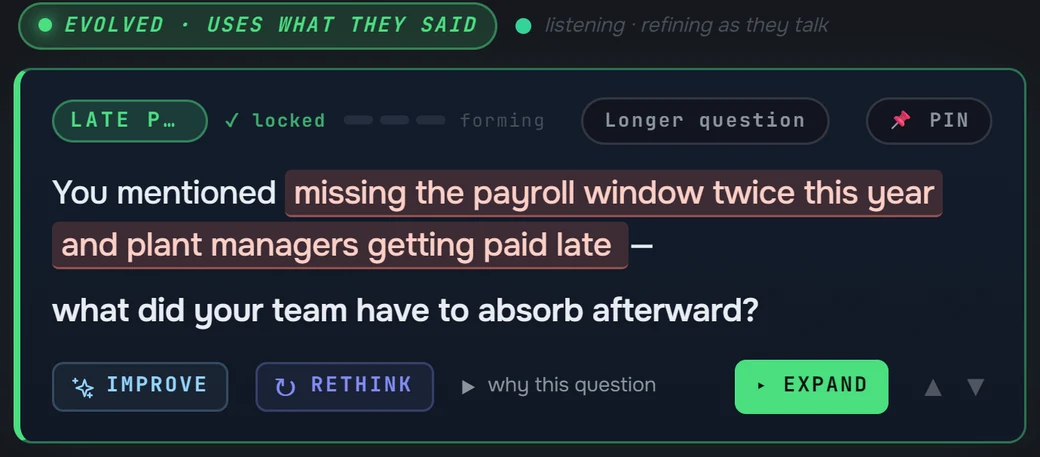
The best impact question builds on something the buyer just said. Veracity's questions follow that rule: while the buyer is still answering, one open question appears on your screen, built on the impact, the cause or what happens next. Then it upgrades in place with their own words.
What is a critical event?
A date with a consequence if it's missed: an audit, a contract that ends, a launch, a new rule that takes effect. "We'd like it by summer" is a wish. "Our audit starts March 1 and we fail it without this" is a critical event. You have it when you know the date and what happens to the buyer if they miss it.
- What date are you working toward?
- What happens if that date passes and nothing has changed?
- What has to be in place before then?
What do you need to know about the Decision?
Who decides, how they decide and what they will judge it on: the people, the steps, the criteria and the reviews a contract goes through. You have it when you can name the person who signs and list the steps between today and a signature.
- Who else will want a say in how this gets fixed?
- What will you use to decide which option is right?
- What happens between now and a decision?
How does SPICED compare to MEDDPICC?
They cover a lot of the same ground. SPICED is built around understanding the problem and why it's urgent. MEDDPICC goes deeper on who decides and how, which matters most on large deals with many people involved. Plenty of teams run discovery with SPICED and check the deal against MEDDPICC later.
| SPICED | MEDDPICC | |
|---|---|---|
| How things work today | Situation | No letter of its own |
| The problem | Pain | Identify pain |
| What it costs | Impact | Metrics |
| Why it's urgent | Critical event | The date in the Decision process |
| Who decides and how | Decision | Economic buyer, Decision criteria, Decision process, Paper process |
| Also covers | No more parts | Champion, Competition |
For each MEDDPICC letter with its own questions, read MEDDPICC explained.
Where does SPICED go wrong?
- Spending the call on Situation. Ten questions about their systems feels like an audit. Ask until you hear the first problem word, such as slow, manual, late or broken, then move to Pain.
- Asking for the impact twice. If the buyer doesn't put a number on it, ask "Who feels it most when it goes wrong?" and come back to the size on the next call.
- Treating a wish as a critical event. A target date with no consequence won't hold. Ask "What happens if that date passes and nothing has changed?"
- Forgetting the person. If fixing it changes nothing for your contact, they won't push for it. Ask "What would fixing this change for you?"
- Asking about the decision in minute one. "Who signs off on this?" before there is a problem to fix puts the buyer on guard. Ask it after the impact.