How many people decide a B2B purchase?
On average, 13 people inside a company are involved in a B2B buying decision, and 89% of purchases involve two or more departments, according to Forrester's State of Business Buying, 2024.1
A first call is usually with one or two of them. So a discovery call has a second job: finding out who else feels the problem, who signs, and what each of them needs to hear.
Ask about the people you can't see
Are you the decision maker?A yes or no question. It puts them on the spot and tells you little about the rest of the group.
You mentioned finance reviews anything over budget. Who there will want a say in this?It uses their own fact and opens up the people you haven't met.
How often do B2B purchases stall?
86% of B2B purchases stall at some point in the buying process, and 81% of buyers are dissatisfied with the provider they chose, Forrester found.1 The same research found that almost 95% of buyers expect to use generative AI in their buying process within the next 12 months.
One way a deal stalls starts on the first call: a pilot agreed before anyone knows what the problem costs. When the pilot ends, nobody can say whether it was worth it.
Do buyers still want to talk to sales?
Fewer of them do, and many arrive having asked AI first. In Gartner's 2026 research, 67% of B2B buyers said they prefer a buying experience without a sales rep.3 Yet 69% said they turn to sales reps to check what AI tools told them.2
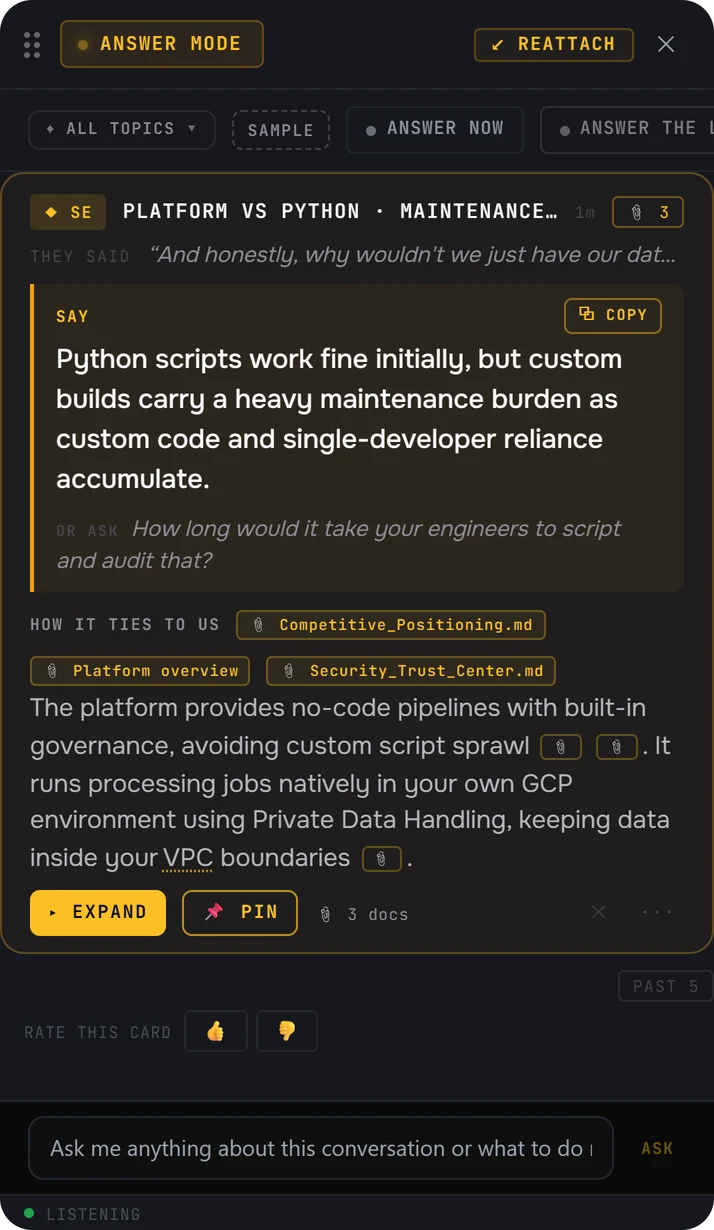
So when a buyer does take the call, they may bring an answer from an AI tool and want it checked. That rewards answers you can back up: from your own documents, with the source named.
Do follow-up questions really help?
In a set of Harvard studies published in 2017, people who asked more questions, especially follow-up questions, were liked more by the people they talked to.4 In chat studies, people told to ask many questions (nine) instead of few (four) were liked more by their partner. The first study had 398 people, and a second with 15-minute chats found the same.
The researchers also studied 110 people at speed-dating events, each going on 15 to 19 four-minute dates. Daters who asked more follow-up questions got more yeses to a second date. And across the studies, people didn't expect that asking questions would make them more liked.
These studies measured ordinary conversations between strangers. They weren't run on sales calls. What carries over is simple: a question that picks up what the other person just said shows you were listening.
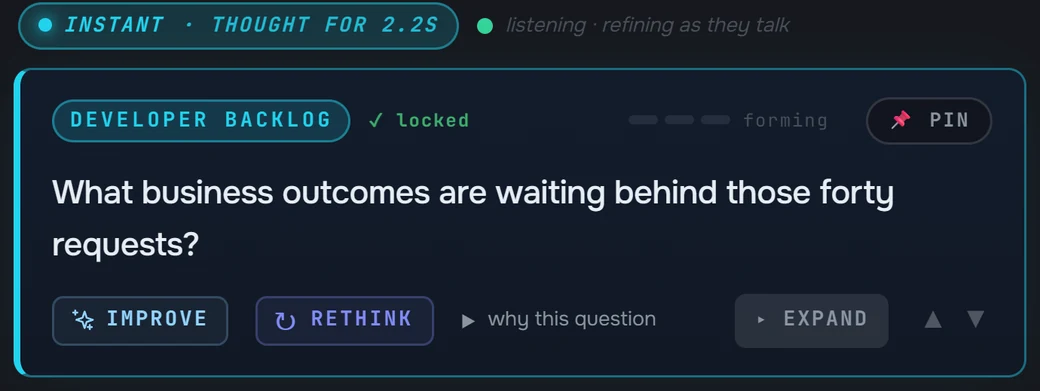
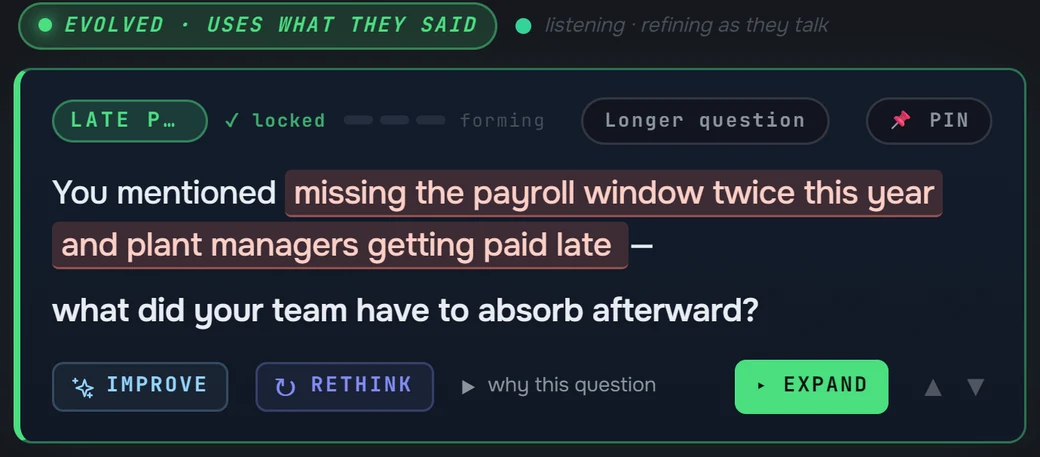
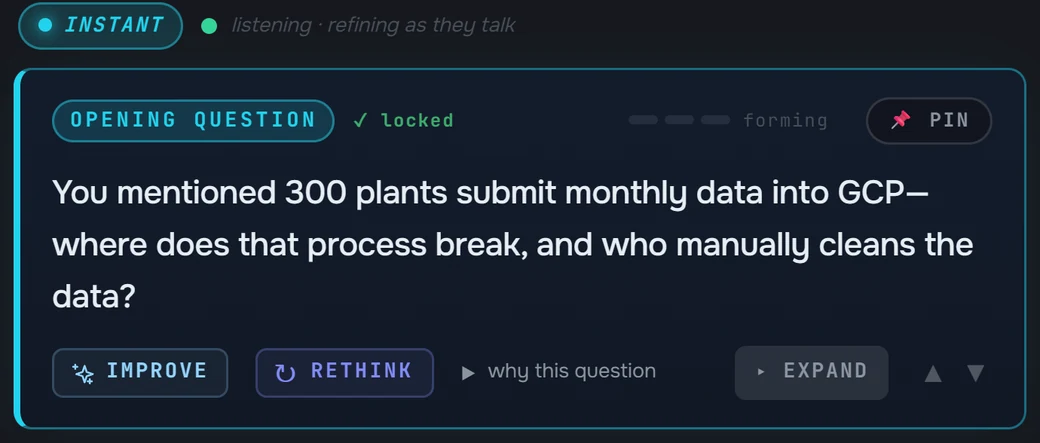
Veracity writes that follow-up while the buyer is still answering. The question on your screen then upgrades to use what they just said: "You mentioned…"
Why do buyers open up when you ask?
Talking about ourselves is rewarding, and it shows up in the brain. Harvard researchers Diana Tamir and Jason Mitchell note that people spend 30–40% of what they say telling others about their own experiences, and they found that sharing about yourself lights up the brain's reward system.5 In their experiments, people gave up money to keep talking about themselves: 17% of what they could have earned in a study of 37 people, and about 25% in another study of 41.
On a discovery call, that means the buyer's problem told in their own words. The rep's part is the question that gets them going, then listening.
What to do with these numbers on your next call
- Ask who else is involved. 13 people decide on average, so start mapping the group on the first call.1
- Find the cost before the pilot. With 86% of purchases stalling, agree on what the problem costs before you agree to a pilot.1
- Be ready to check what AI told them. 69% of buyers turn to reps to validate AI answers, so have your documents within reach.2
- Follow up on their words. People who ask follow-up questions are liked more by the people they talk to.4
- Let them talk. People give up money to talk about themselves. Ask, then listen.5
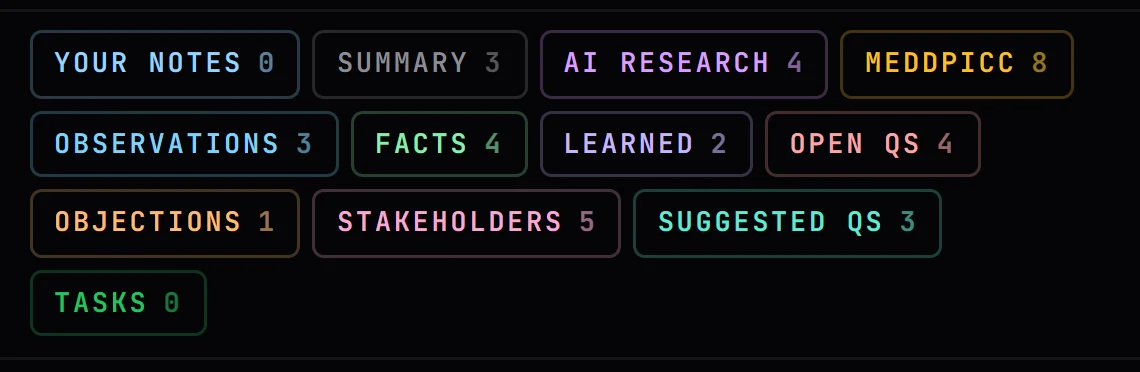
For the questions themselves, read how to run a discovery call and MEDDPICC, with questions for each letter.
Where every number comes from
Each figure is quoted the way its publisher states it. All five sources were checked on October 29, 2026.
- 1Forrester. "Forrester: To Master B2B Buying Mayhem, Providers Must Prioritize Buyers' Needs." Press release on The State Of Business Buying, 2024. December 4, 2024. forrester.comUsed for: 13 people, 89% two or more departments, 86% stall, 81% dissatisfied, almost 95% expect to use generative AI.
- 2Gartner. "Gartner Survey Finds 69% of B2B Buyers Turn to Sales Reps to Validate AI-Generated Insights." Press release. May 20, 2026. gartner.comUsed for: 69% turn to sales reps to check AI answers.
- 3Gartner. "Gartner Sales Survey Finds 67% of B2B Buyers Prefer a Rep-Free Experience." Press release. March 9, 2026. gartner.comUsed for: 67% prefer buying without a sales rep.
- 4Huang, K., Yeomans, M., Brooks, A. W., Minson, J., & Gino, F. (2017). "It doesn't hurt to ask: Question-asking increases liking." Journal of Personality and Social Psychology, 113(3), 430–452. doi.org/10.1037/pspi0000097Used for: the chat studies (398 people; 15-minute chats), the speed-dating study (110 people, 15 to 19 four-minute dates each), and that people don't expect questions to raise liking.
- 5Tamir, D. I., & Mitchell, J. P. (2012). "Disclosing information about the self is intrinsically rewarding." Proceedings of the National Academy of Sciences, 109(21), 8038–8043. doi.org/10.1073/pnas.1202129109Used for: 30–40% of speech, the reward system finding, 17% and about 25% of earnings given up.