What did the 2017 question studies find?
In a set of Harvard studies published in 2017, people who asked more questions, especially follow-up questions, were liked more by the people they talked to.1
The first study had 398 people. In each pair, one partner was told to ask at least nine questions or at most four during a 15-minute chat. The partners who were told to ask more were liked more. A second study, with the same instructions given to both partners, found the same.1
Do follow-up questions work in a short conversation?
The same researchers studied 110 people at speed-dating events. Each went on 15 to 19 dates, four minutes each. Daters who asked more follow-up questions got more yeses to a second date.1
One more finding matters for anyone who sells. Across the studies, people didn't expect that asking questions would make them more liked.1 So it's easy to skip on a call: asking doesn't feel like it's helping.
Why do people like being asked about themselves?
Talking about yourself is rewarding, and it shows up in the brain. Harvard researchers Diana Tamir and Jason Mitchell note that people spend 30–40% of what they say telling others about their own experiences. In their own experiments, sharing about yourself lit up the brain's reward system.2
People even gave up money to keep doing it.2
A follow-up question is an invitation to keep going. It tells the buyer you heard what they said, and it asks them for more of the thing people already like to talk about: their own work and what happened to it.
What does a good follow-up sound like on a discovery call?
A follow-up picks up a fact the buyer just gave you and asks about it. A generic prompt could follow any answer, so it shows nothing about what you heard.
Can you tell me more about that?It fits after any answer, so the buyer can't tell what you heard.
You mentioned five or six plants send the wrong format. What does that do to payroll and comp?It uses the buyer's own words and asks what they lead to.
Three follow-ups, built on what the buyer said
A strong follow-up builds on one of three things: what the problem costs, what causes it, or what happens next.
They said: "We close the books two days late every month."
"You mentioned the books close two days late. What does that hold up for your team?"
They said: "The plant files come in five different formats."
"You mentioned five different formats. Where in the process do the files start to differ?"
They said: "Finance wants this fixed before the audit."
"You mentioned the audit. What happens if this is still broken when it starts?"
Each one is a single open question, and each uses only what the buyer said. None asks them to pick between two options. For a full call plan, read how to run a discovery call.
How does Veracity write the follow-up for you?
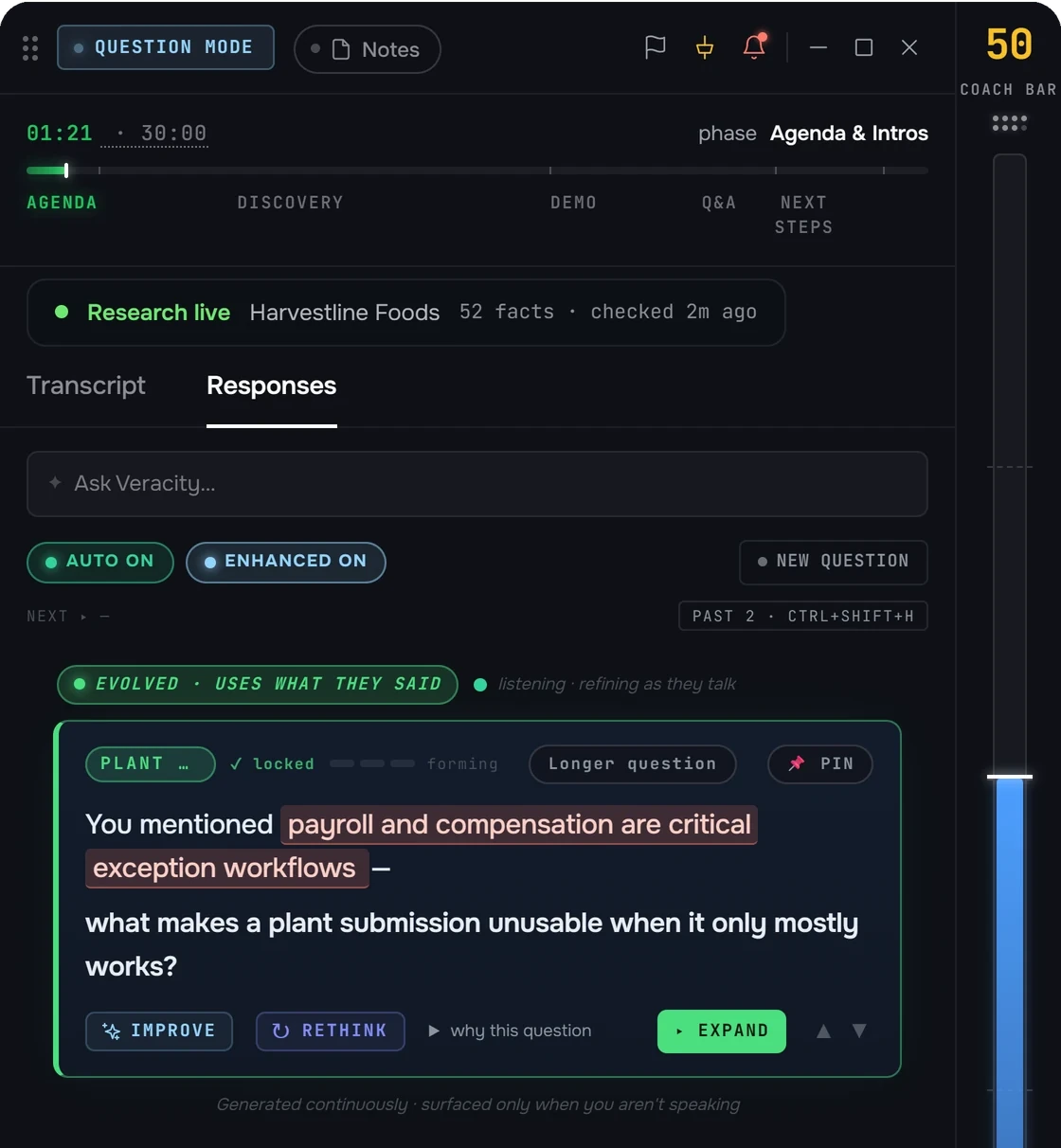
While the buyer is still answering, Veracity writes one open question of 20 words or fewer. As they keep talking, the question upgrades in place to use what they just said: "You mentioned…" Nothing on the card changes while you're talking.
Every question follows the same rules as the examples above: one open question, built on the impact, the cause or what happens next, using only facts the buyer said, and never a choice between two options. See how live question suggestions work.
What don't these studies tell you?
- They weren't sales calls. The studies measured chats between strangers and speed dates.1
- They measured liking and second dates. No study here measured a deal, a pipeline stage or a purchase.
- They studied strangers. The pairs had just met, with nothing to buy or sell between them.
What carries over is simple. A question that picks up the buyer's last answer shows you were listening, and it keeps them talking about their own problem. For the numbers on who else is in the deal, read how many people decide a B2B purchase.
Where every number comes from
Each figure is quoted the way its authors state it. Both sources were checked on October 29, 2026.
- 1Huang, K., Yeomans, M., Brooks, A. W., Minson, J., & Gino, F. (2017). "It doesn't hurt to ask: Question-asking increases liking." Journal of Personality and Social Psychology, 113(3), 430–452. doi.org/10.1037/pspi0000097Used for: more questions, especially follow-ups, and more liking; the first study (398 people, told to ask at least nine or at most four questions); the 15-minute chats; the speed-dating study (110 people, 15 to 19 four-minute dates each); and that people don't expect questions to raise liking.
- 2Tamir, D. I., & Mitchell, J. P. (2012). "Disclosing information about the self is intrinsically rewarding." Proceedings of the National Academy of Sciences, 109(21), 8038–8043. doi.org/10.1073/pnas.1202129109Used for: 30–40% of speech, the reward system finding, 17% and about 25% of earnings given up.