How do you prep for a sales call fast?
Give yourself a hard stop. Fifteen minutes is enough for a first call if you know what you are looking for. Set a timer, give each block three minutes, and write one or two lines per block in the notes you'll have open on the call.
What should you look up about the company?
Three things: what they sell, who they sell to, and what changed in the last few months. Look at their home page and product pages, their newsroom or press page, and their careers page. A wave of open roles in one team tells you where they are spending.
Write down: one line on what they do, and one recent change, such as a new product, a new market, an acquisition or a new leader.
What should you know about the people?
For each person on the invite: their title, how long they have been in the role, and what someone in that seat is usually measured on. A head of finance is judged on close speed and accuracy. A head of IT is judged on uptime and how much time goes to maintenance.
Then think about who is missing from the invite. On average, 13 people are involved in a B2B buying decision, according to Forrester's 2024 buying research.1 Note the titles you'd expect to have a say, so you can ask about them on the call.
Write down: each person's title and one thing they are probably measured on.
What do you need from your last call?
Your notes from earlier calls hold the only facts the buyer gave you themselves. Read them for three things: the problem in their words, any number they gave you, and anything you promised to send or find out.
Write down: the one fact from last time you want to build on, in their words.
Why make one guess about their problem?
A guess tells you what to listen for. Write it as one sentence: "I think their month-end close breaks at the plant files, and it costs the finance team days every month." You won't say it to the buyer. You'll ask open questions and listen for whether they confirm it.
Then think about what they may already have read. In Gartner's 2026 research, 69% of B2B buyers said they turn to sales reps to validate AI-generated insights.2 Open the documents a buyer like this is most likely to ask about, so you can check a claim during the call.
Write down: your guess, and the two documents you'll keep open.
What should your opening question be?
One open question, written out in full. On a first call, ask why they took it. On a follow-up call, build on the fact you wrote down from last time.
- What's prompting you to look at this now?
- You mentioned last time that the plant files arrive late. What has happened since then?
Then stop. Fifteen minutes of prep and one good question beat an hour of reading and a list of ten. For what to ask after the opener, read how to run a discovery call.
Can software do the prep for you?
Veracity does most of these blocks before you open the call. Before every call, Veracity searches the web about your prospect's company and reads their website. It pulls recent, checked news about the account into your call prep.
It also researches the people you're meeting by title and industry: what someone in their seat is measured on and worried about. Earlier calls with the same company feed the call as a brief you can edit or switch off. When the call starts, an opening question is ready, and the briefing reaches every question you get.
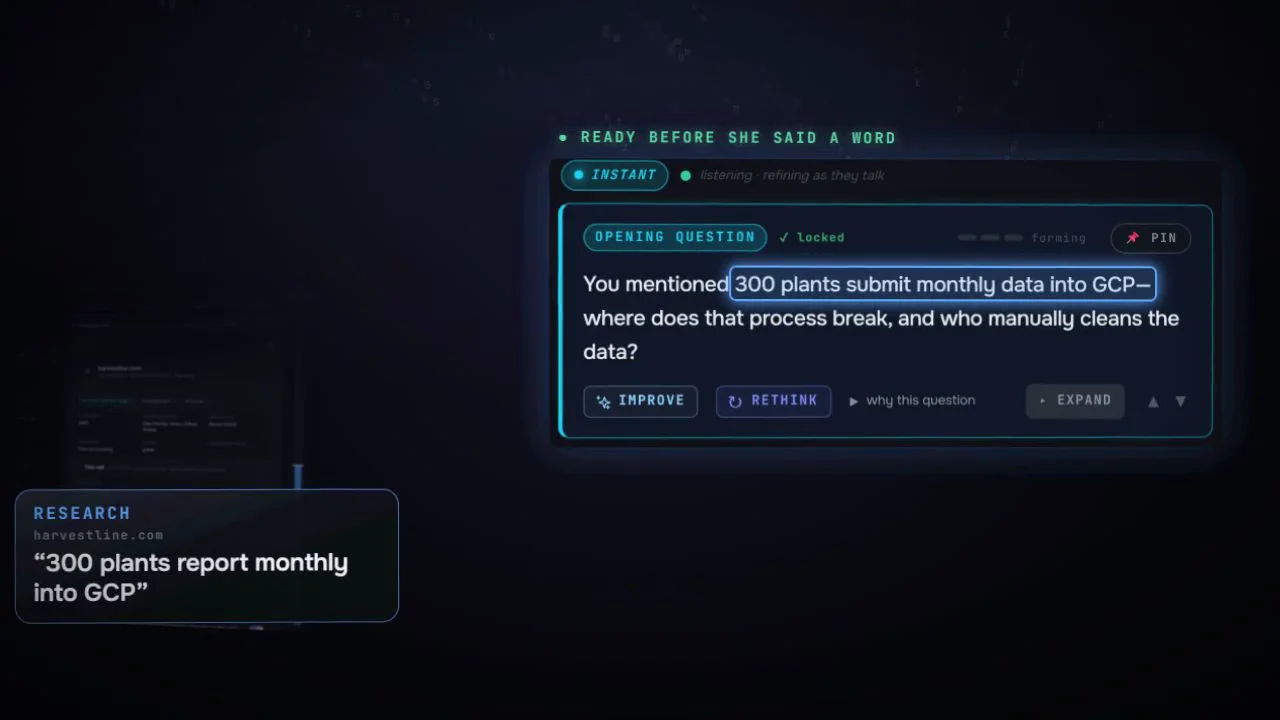
See what goes into the research: pre-call research that carries into the call.
What wastes prep time?
- Reading until the call starts. An hour of research with no question written is worse than 15 minutes with one. Stop when the timer does.
- Writing ten questions. You will ask the first one and then follow the buyer. Write the opener and let their answer pick the rest.
- Skipping the last call's notes. They hold the buyer's own words, which beat anything you find online.
- Pitching your guess. If you open with "I bet your close is slow", they'll agree to be polite. Ask "Where does it break most often?" and listen for it.
Where the numbers come from
- 1Forrester. "Forrester: To Master B2B Buying Mayhem, Providers Must Prioritize Buyers' Needs." Press release on The State Of Business Buying, 2024. December 4, 2024. forrester.comUsed for: 13 people involved in the average B2B buying decision.
- 2Gartner. "Gartner Survey Finds 69% of B2B Buyers Turn to Sales Reps to Validate AI-Generated Insights." Press release. May 20, 2026. gartner.comUsed for: 69% turn to sales reps to validate AI-generated insights.
More on how buyers research before a call: how buyers use AI before they talk to you.