What is SPIN Selling?
SPIN Selling is a questioning method for B2B sales calls, built for larger deals where the buyer needs a strong reason to change. The four letters name four types of question. Each type moves the buyer a step closer to deciding the problem is worth fixing.
The method draws a line between two kinds of need. An implied need is a complaint: "Our reports are always late." An explicit need is something the buyer says they want: "We need the reports ready before the board meets." In a large deal, a complaint rarely turns into a project. Implication and Need-payoff questions are how a complaint grows into a need the buyer states out loud.
Ask them roughly in order. You need to know the situation before you can find a problem in it, and you need a problem before you can ask what it leads to. When the buyer opens a new problem, go back a step and follow it.
What are Situation questions?
Questions about the facts: how the work gets done today, the systems, the team and who owns what. You need a few. Buyers get the least out of them, though, because the answers tell them nothing new, and a long run of them feels like an audit. Look up what you can before the call and ask only what you can't find. You have it when you know enough about their setup to ask where it goes wrong.
- How does this get done today, from start to finish?
- Who on the team handles it day to day?
- What has changed about how you do this in the last year?
What are Problem questions?
Questions about what's hard or slow in the situation. They draw out the complaints the method calls implied needs. A problem on its own is rarely enough to buy, so treat it as the start of the next question. You have it when the buyer has named a problem in their own words and told you about a recent time it happened.
- Where does that process slow down or break?
- What happened the last time it went wrong?
- What part of it takes more time than it should?
What are Implication questions?
Questions about what a problem leads to: the delays it causes further down the line, and who else it reaches. They make a small complaint big enough to act on. They're also the hardest of the four to ask well, because each one has to build on a problem the buyer just named. You have it when the buyer has told you what the problem leads to, and how big that is in their own units.
- What does that delay do to the teams that rely on it?
- What happens to your customers when that goes wrong?
- What has the team had to drop to keep up with it?
What are Need-payoff questions?
Questions that ask the buyer what solving the problem would be worth to them. The buyer lists the benefits in their own words, so they own them and can repeat them to the people who sign off. Ask them after the implications are on the table. Earlier than that, the buyer has no reason to care. You have it when the buyer has told you, before any pitch, what fixing it would change for them.
- What would change for the team if that stopped happening?
- What would the team do with the hours they spend on it now?
- What would fixing this mean for the goals you're measured on?
What does SPIN sound like on a call?
Say you're on a first call with a head of customer support. Each question builds on the answer before it, and the four types come up in order.
How do support tickets reach the right engineer today?Situation. One fact you couldn't look up before the call.
They land in a shared inbox, and a team lead sorts them every morning.
You mentioned a team lead sorts them every morning. What's the hardest part of that sort?Problem. It looks for what's hard in the process they just described.
Urgent tickets get buried. Sometimes a customer waits a full day before anyone sees theirs.
You mentioned a customer can wait a full day. What happens with that customer afterward?Implication. It asks what the problem leads to.
Twice this quarter it was a large account, and both times it went up to our VP.
You mentioned both times it went up to your VP. What would change for you if that stopped happening?Need-payoff. The buyer says what fixing it is worth, in their own words.
I'd stop spending Monday mornings explaining what went wrong.
That last answer is the one to write down. It's the buyer's own reason to change, and it's the line they'll use when they take this to their VP. The rep never mentioned the product, and every question after the first used something the buyer had just said.
How does SPIN compare to SPICED?
They cover a lot of the same ground. SPIN gives you four types of question to move the conversation along. SPICED is a list of what you need to know by the end of discovery, and it adds two things SPIN has no question type for: the date that makes the problem urgent, and how the buyer will decide.
| SPIN | SPICED | |
|---|---|---|
| How things work today | Situation | Situation |
| The problem | Problem | Pain |
| What it leads to and costs | Implication | Impact |
| What fixing it is worth to the buyer | Need-payoff | Part of Impact |
| Why it's urgent | No question type of its own | Critical event |
| Who decides and how | No question type of its own | Decision |
For each SPICED part with its own questions, read SPICED explained.
Where does Veracity help?
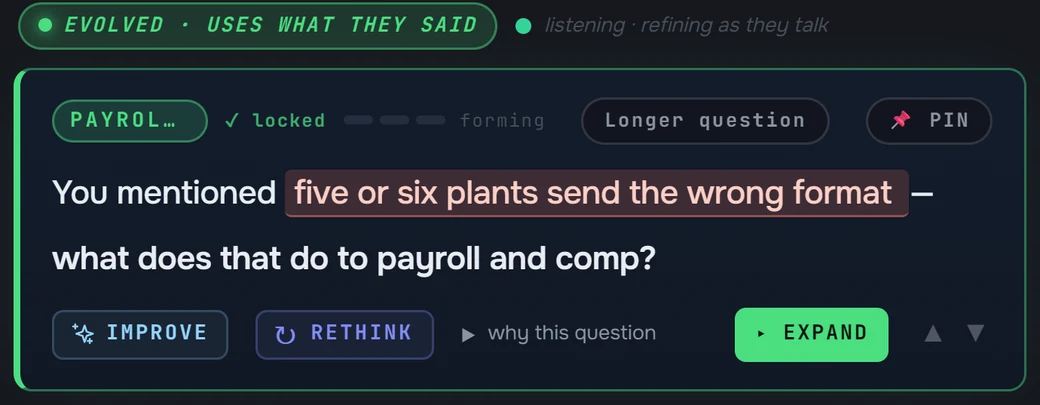
Veracity helps with the follow-up, the step where each question has to build on what the buyer just said. While the buyer is still answering, it puts one open question of 20 words or fewer on your screen, built on the impact, the cause or what happens next, using only facts the buyer said. As they keep talking, the question upgrades in place with their own words: "You mentioned…"
Where does SPIN go wrong?
- Too many Situation questions. Ten questions about their systems wears the buyer out, and most of the answers were there to find before the call. Ask a few, then look for the first problem.
- Pitching at the first problem. When the buyer names a problem you fix, it's tempting to show the product. A complaint is still only an implied need. Save the product until the buyer says what they want fixed.
- Jumping to Need-payoff. "What would it mean if this were fixed?" before any implication gets a shrug, because the problem still feels small. Ask an Implication question first.
- Leading Need-payoff questions. "Wouldn't it be great if tickets sorted themselves?" gets a polite yes you can't use. Ask "What would change for you if that stopped happening?" and let them name the benefit.
- Implications from your script. "I bet that hurts your renewals too?" puts words in their mouth. Build each Implication question on something they said.