What goes in a discovery call template?
Five parts, each with one job. They run in this order because each part needs the answers from the one before it. Keep the template open beside the call, and keep an eye on the clock so the last part doesn't get squeezed.
How should you open a discovery call?
Agree what the call is for before you dig in. Say how long you have, what you'd like to learn, and how the call will end. Then hand the buyer the floor.
Thanks for your time. Let me start with a quick overview of who we are.The buyer sits back and waits for the demo, and you've used the minutes meant for them.
Thanks for making the time. We have 30 minutes. I'd like to learn how [the process] works today and where it gets in the way, and at the end we can decide together whether a next step makes sense. What would you like to get out of today?It says how long, what you'll cover and how it ends, then asks what they want from it.
Then ask why they're here. The question depends on who asked for the call.
- What made you want to talk about this now?
- What made you say yes to a call?
What do you ask about the buyer's situation?
Get the process from start to finish before you look for problems in it: the steps, the teams and the tools. Use their names for things. When you hear the first problem word, such as slow, manual, late or stuck, move on to Part 3.
- What happens from the moment a request comes in to when it's done?
- Which teams does it pass through on the way?
- What do you use to run it today?
How do you find the problem and what it costs?
This is the longest part, because the rest of the deal hangs on it. Find the step they'd fix first and a recent time it went wrong, then ask for the size in their own units: hours, days, people or money. Ask for the number once. If they don't have one, ask who feels it most and come back to the number on the next call.
- Which step would you fix first if you could?
- What did the team have to do the last time it went wrong?
- How much of the team's week goes into working around it?
What do you need to learn about how they decide?
Ask about the decision once the problem has a size. You need the other people with a say, how the company bought something like this before, and the date they're working toward.
- Who would need to agree before anything changes?
- How did the team choose the tool you use now?
- What's driving the timing on this?
For a fuller checklist of who decides and how, see MEDDPICC, with questions for each letter.
How do you end a discovery call?
Start this part at minute 26, even if the conversation is going well. Play back what you heard in the buyer's words and check it. Then book the next meeting while everyone is still on the call.
Here's what I heard: [the problem], which costs you [their number], and [names] would want a say before anything changes. What did I miss?Their words back to them. If you got something wrong, this is when they'll correct it.
- What would be most useful to see next?
- Who else should be in that meeting?
- Which day next week works for the follow-up?
Should you read a discovery call script?
A script decides your next question before you've heard the answer. The template only sets the goal of each part, so the buyer's last answer can choose your next question. When the buyer says something specific, follow it before you move on.
Say you're in Part 2 and the buyer tells you: "Setting up a new customer takes us about three weeks, and most of that is waiting on their data."
Got it. And what tools do you use today?The next line on the script. It walks past the most useful thing they've said so far.
You mentioned waiting on their data. What happens to the go-live date while you wait?It uses their own words and asks what the wait leads to. You've just moved into Part 3 without a script telling you to.
For three ways to follow up on one answer, read how to run a discovery call.
What should you have written down by the end?
One line or two per part, in the buyer's words. Here is the sheet from the example call above, with a head of customer operations at a software company.
| Write down | Example call | |
|---|---|---|
| 1. Open and agenda | Why they took the call, in their words | New customer setup takes too long, and fixing it is a goal for this quarter |
| 2. Their situation | The steps in order, the teams and the tools | Sales hands over, an onboarding lead collects the customer's data, the data team loads it, the customer goes live. Tracked in spreadsheets |
| 3. The problem and its cost | The problem, one recent example, their number | About three weeks per new customer, mostly waiting on the customer's data. Last month a go-live slipped because one customer's files came in late |
| 4. How they decide | Everyone with a say, how they bought last time, the date | The VP of customer success approves. The data team lead will want a say. The current tool was picked after a trial. Wants it fixed before the new year |
| 5. The next step | The date, who's coming, what you'll bring | Tuesday at 10, with the data team lead. Bring a setup plan for one customer |
If a row is empty when you hang up, that's the first thing to ask about on the next call.
Where does Veracity fit in a discovery call?
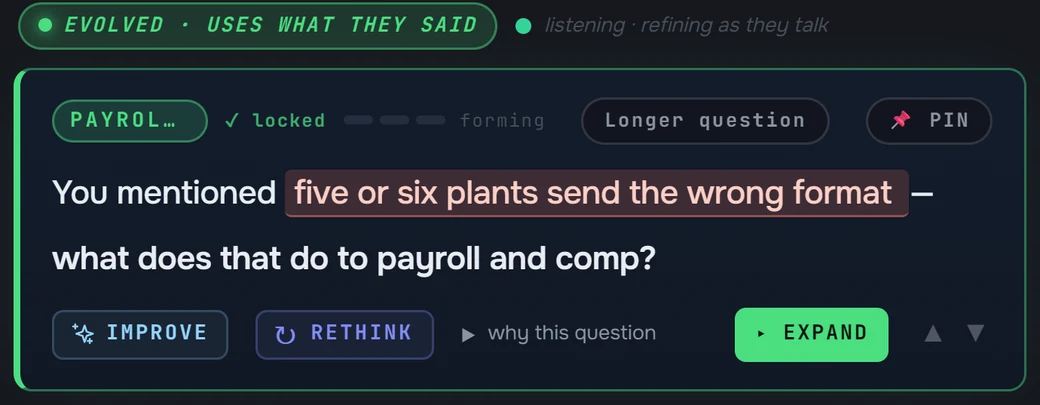
Veracity helps with the parts that are hard to do while you're listening. When the call starts, an opening question is ready, built from your prep, your research and your earlier calls with the account. While the buyer is still answering, it writes one open question of 20 words or fewer, then upgrades it in place with what they just said: "You mentioned…" Nothing on the card changes while you're talking.
During the call it keeps live notes, with sections that include Summary, Facts, Open questions, Stakeholders and Tasks. Check them against your sheet before you hang up.
Where do discovery call templates go wrong?
- Reading the questions in order. The buyer can tell when your next question ignores their last answer. Use the questions to start each part, then follow what they say.
- Skipping the agenda. If the buyer doesn't know what the 30 minutes are for, they may ask for a demo before you know the problem.
- Staying in the situation too long. Ten minutes on how things work feels like an audit. Move to Part 3 when you hear the first problem.
- Running out of time for the next step. Start the playback at minute 26. A good conversation with no date on the calendar tends to drift.
- Writing your words on the sheet. "Onboarding is inefficient" is your summary. "Three weeks, mostly waiting on their data" is what they said, and it's what you'll build the next call on.