What should you write in the CRM after a sales call?
Write for whoever opens the deal next: your manager, a sales engineer, or you the morning of the next call. They need the facts the buyer gave you and what happens next. A good note has six parts.
Good call. They have reporting problems and seem very interested.Your impression of the call. The next person on the deal can't act on it.
Problem: the forecast is built by hand from three spreadsheets, and it's wrong by the time the board sees it.Their words show what's broken and why it matters to them.
If your team qualifies deals with MEDDPICC, these lines fill four of its letters: the problem is Identify pain, the cost is Metrics, and who decides and how cover the Economic buyer and the Decision process. For the rest, see MEDDPICC explained, with questions for each letter.
A sales call note template you can copy
Paste this into the notes on the deal in your CRM and fill in the brackets. Keep each line to a sentence or two.
- Call: [date] · [first call or follow-up] · [who was on it] Problem, in their words: "[the sentence they used]" What it costs: [their number, in their units] Who decides, and how: [who signs, who has a say, the steps] Open questions: [what you still need to find out, from whom] Objections: [their pushback, in their words, and your reply] Next step: [what] · [who's coming] · [date and time]
If you don't know a line yet, write "unknown" and keep it. An empty line tells the next person what to ask on the next call.
What does a good call note look like?
Here is the template filled in after a first call with a head of finance at a manufacturer. It's an example: the call, the company and the people are made up.
Nov 3 · first call, 30 min · Head of Finance. The payroll manager joined for the last 10 minutes.
"Five or six of our plants send their files in the wrong format, and my team fixes them by hand every month."
"It takes two days of my team's month." Payroll went out late twice this year, and plant managers were paid late both times.
The CFO approves the spend. IT reviews anything that touches payroll data. She runs the evaluation and takes one option to the CFO.
How long the IT review takes, and who runs it. What the late payroll cost beyond the two days of fixes.
"We sent the plants a file template last year. Most of them ignored it." I asked what got in the way; she wasn't sure. Ask the payroll manager next time.
Second call · Nov 12, 10:00, 45 min · her and the payroll manager · walk through last month's files. I send the invite today and the agenda by Nov 10.
Every quote is something the buyer said, and every number came from them. Someone who wasn't on the call can read it in a minute and know what's broken, what it costs, who signs and when the next call is. Before that call, it's the first thing to read: see how to prep for a sales call in 15 minutes.
What makes a next step real?
A real next step has a date, the people coming and a reason to meet. "Follow up next week" has none of them, and it's how deals go quiet. Agree the next step on the call, before you hang up, and write it the way you agreed it.
Next step: follow up next week.No date, no people, no reason. Nobody owns it.
Next step: demo on their own files, Nov 17 at 2:00, with the buyer and her IT lead. I send the invite today.Anyone on your team can read it and know what happens next, and who has to do what.
To get there, ask before the call ends: "What would you want the next call to cover?" Their answer gives you the reason to meet and tells you who should be on it. If the buyer wouldn't agree to a date, write that down too. It tells your manager more than a hopeful "follow up".
Can software take the notes for you?
Veracity is a desktop app that keeps live notes while you talk, so you can listen instead of typing. The notes have tabs for Summary, MEDDPICC, Facts, Open questions, Objections, Stakeholders, Tasks and more. Open questions and Objections are lines of the template, and Tasks holds the next steps someone agreed to. After the call, you get a recap with Diagnosis, MEDDPICC, Risks and Improve sections.
Veracity doesn't update your CRM. You still write the note, and the live notes give you what the buyer said to write it from. They come from what was said on the call, so read them before you update the deal.
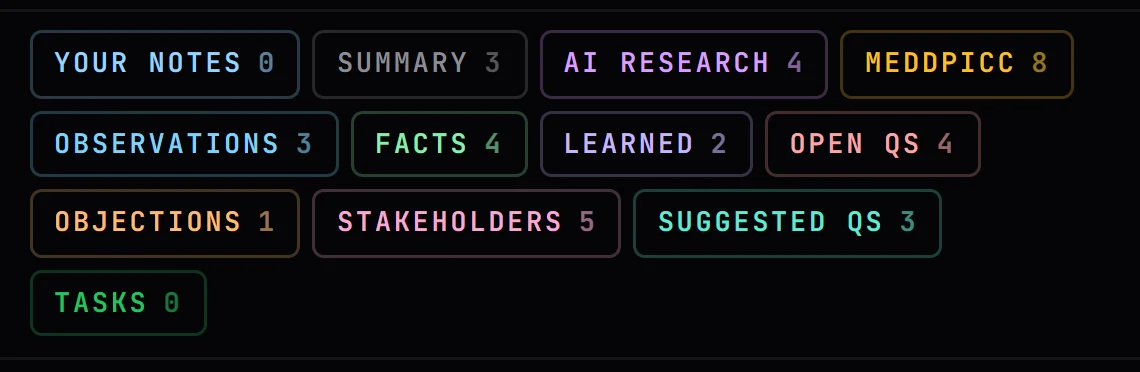
See what goes in each tab: live call notes, MEDDPICC filled in as you talk.
What makes a call note useless?
- Writing your opinion of the call. "Very interested" is your read. Write what they said that made you think so.
- Retelling the whole call. The next person needs the facts and the next step. Keep to the lines of the template.
- Taking a title for the person who signs. Write who approves the spend once the buyer has told you. Until then, it's an open question.
- Writing it up at the end of the week. By Friday you remember your version of what they said. Write the note before your next call.