What does a CTO walk into the call caring about?
A CTO or VP of Engineering decides early in the call whether you understand their systems or are reading a script. Read this before you dial, and listen for these on the call.
- Uptime against what they've promised the business
- How long integrations and rollouts take
- How much of the team's time goes to maintenance
- Security and compliance
- Engineering speed, and the technical debt slowing it
- An integration that fails halfway and eats the roadmap
- One more system to maintain
- A security gap they'll have to explain upstairs
- Being told to build it in-house when the team has no time for it
Veracity's pre-call research builds this kind of picture for each person you're meeting, from their title and industry: what someone in their seat is measured on and worried about. See pre-call research.
What should you ask a technical buyer, stage by stage?
Six stages, in the order a technical discovery call usually runs. Each one has what you're trying to learn, questions you can ask as written, and an example of how a real answer becomes your next question.
1. Their current setup
Learn how it works today, in their words, before you say anything about yours.
- What does your setup look like today for the part of the business we'd touch?
- How does data get from the system you have now to the people who use it?
- What does your team spend time maintaining that it would rather not?
The core platform is ours. Then there are a couple of older tools bolted on that nobody really owns.
You mentioned older tools that nobody really owns. What happens when one of them breaks?
2. Where it hurts
Find the problem they'd fix first, and how they found out about it.
- What was the hardest integration your team took on in the last year?
- What breaks most often in the current setup?
- The last time it broke, how did you find out?
The last integration ran way past plan. We pulled two engineers off the roadmap to finish it.
You mentioned two engineers came off the roadmap. What did the roadmap lose while they were on it?
3. What it costs them
Get them to put a number on it. Their number, never yours. Ask for it once. If they don't give one, ask "What does the business side see when it breaks?" and move on.
- How many engineering hours a sprint go into keeping it running?
- What happens to the roadmap if this rollout slips?
- What does the business side see when it breaks?
The sync between the two systems is brittle. Someone ends up fixing it by hand most weeks.
You mentioned someone fixes the sync by hand most weeks. How many hours a sprint does that take?
4. Build or buy
Most CTOs could build it. Find out what building would cost them, in their terms.
- What would your team stop working on if you built this yourselves?
- What would have to be true for buying to beat building?
- How did the last build-or-buy decision go on your team?
We could probably build this ourselves. We've got good people.
You mentioned you could build this yourselves. What would the team stop working on to do it?
5. Security and sign-off
Learn the path to yes before you need it, and what has stalled vendors here before.
- What does a vendor have to show your security team before they sign off?
- What does sign-off on a technical review look like on your side?
- What has stalled a vendor review here before?
If the next step is a proof of concept, qualify it first: how to qualify a POC before you agree to run it.
6. Where they want to be
Get them to describe the result they want, then play back what you heard.
- What would your team be doing differently a year from now if this worked the way you want?
Then play the call back in their words: "Here's what I heard. The older tools are nobody's job, someone fixes the sync by hand most weeks, and the last integration pulled two engineers off the roadmap. What did I get wrong?" If they correct something, write the correction down. It is the most accurate version of their problem you will get.
Which questions should you stop asking a CTO?
Each of these gets a short answer or puts them on defense. Ask the one below it instead.
Are you on-prem, in the cloud or hybrid?A menu. They pick one and stop talking.
How does that part of the business run today?
Do you have problems with integrations?Yes or no, and the answer will be no.
What was the hardest integration your team took on in the last year?
Why haven't you fixed the sync yet?"Why" sounds like blame.
What's made the sync hard to fix so far?
Would saving engineering time be valuable to you?There's only one answer, and they know it.
How many engineering hours a sprint go into keeping it running?
After a real call, Veracity's Question Tutor grades every question you asked and gives you the sentence you could have said instead. See call grading.
What do you do when a technical buyer tests you?
They'll ask something specific to see if you know your product: an API limit, where data is stored, what happens when a sync fails halfway. Don't bluff. Give the exact answer if you have it. If you don't, say "I don't know that one. What decision depends on it?" Their answer often tells you more about the deal than the fact would have.
Some arrive with an answer from an AI tool and want it checked. In Gartner's 2026 research, 69% of B2B buyers said they turn to sales reps to validate AI-generated insights.1 So the answer you give has to come from your real documentation.
That is the part Veracity covers on the call. It answers from your own product documents and names the files it used. When your documents don't cover the question, it says so instead of guessing. It never tells you to loop in your SE: the line on screen is one you can say yourself.
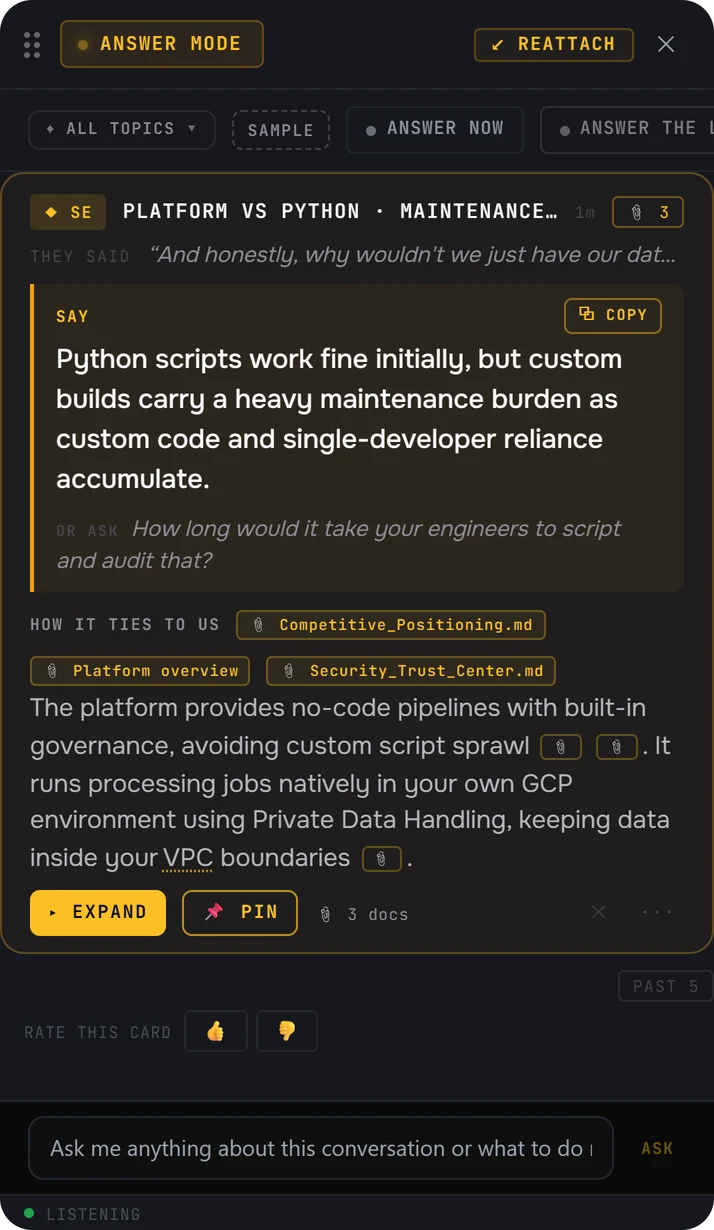
More on this: technical answers from your own docs.
Where the number comes from
- 1Gartner. "Gartner Survey Finds 69% of B2B Buyers Turn to Sales Reps to Validate AI-Generated Insights." Press release. May 20, 2026. gartner.comUsed for: 69% turn to sales reps to validate AI-generated insights.